

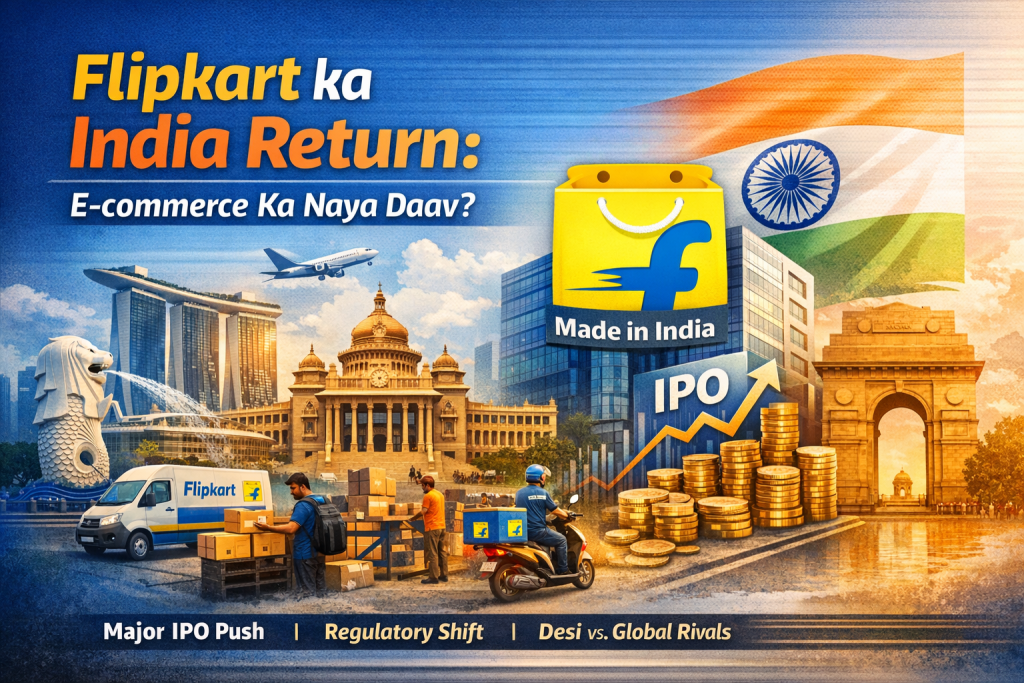
Flipkart’s decision to shift its legal domicile and headquarters back to India marks one of the most consequential strategic moves in Indian e-commerce in recent years. Framed as a “return to Indian roots,” this is not merely a symbolic homecoming or corporate restructuring exercise. It is a calculated, high-stakes bet—a naya daav—that could significantly reshape India’s e-commerce landscape, influence investor confidence, unlock one of the country’s largest IPOs, and intensify competition with rivals such as Amazon India, Reliance Retail’s JioMart, and fast-growing value-commerce players.
At a time when India’s digital economy is maturing, regulatory frameworks are tightening, and capital markets are rewarding domestic champions, Flipkart’s move signals a shift from growth-at-any-cost to long-term institutional credibility. The question is no longer whether Flipkart can survive—but whether this “India Return” can help it dominate the next decade of Indian e-commerce.
The Background: Flipkart’s Journey and the Singapore Chapter
Flipkart was founded in 2007 by Sachin Bansal and Binny Bansal in Bengaluru as a modest online bookstore. What followed was a defining chapter in India’s internet economy. Flipkart pioneered features that later became industry standards—cash-on-delivery, no-questions-asked returns, and large-scale festive discounting through events like The Big Billion Days.
By the mid-2010s, Flipkart had grown into India’s largest homegrown e-commerce platform, competing fiercely with Amazon. However, the capital-intensive nature of e-commerce meant continuous fundraising, mounting losses, and pressure to scale faster. In 2018, Walmart acquired a controlling stake in Flipkart for approximately $16 billion—then the largest e-commerce deal globally. Over time, Walmart increased its ownership to around 85–90% through various entities.
Following the acquisition, Flipkart’s holding structure was based in Singapore. This was neither unusual nor controversial at the time. Many Indian startups—Paytm, Ola, Swiggy, Zomato (initially), and others—chose offshore incorporation for practical reasons:
-
Easier access to global capital
-
Predictable tax regimes
-
Fewer restrictions on foreign investment
-
Proximity to Asian financial markets
Singapore, in particular, offered regulatory stability, favorable taxation, and credibility among international investors.
However, as India’s startup ecosystem matured, this offshore structure increasingly attracted criticism. Policymakers, domestic investors, and even public sentiment began favoring companies that were legally rooted in India—especially those serving Indian consumers at scale.
What the “India Return” Actually Means
In 2025, Flipkart announced its intention to shift its legal domicile from Singapore back to India—a process often referred to as “re-domiciliation.” By late 2025, the National Company Law Tribunal (NCLT) approved the restructuring, clearing a major regulatory hurdle.
This move involves several concrete changes:
1. Legal Domicile Shift
Flipkart’s parent entity transitions into an Indian company governed by the Companies Act, 2013. This places the firm squarely under Indian corporate law, taxation, and regulatory oversight.
2. Headquarters Repositioning
While Flipkart’s operational base has always been Bengaluru, the legal and symbolic headquarters now formally reside in India. This reinforces Flipkart’s identity as an Indian enterprise rather than a foreign-controlled subsidiary.
3. IPO Alignment
Most importantly, the restructuring aligns Flipkart for a potential Indian IPO, widely expected in 2026. Market estimates have previously valued Flipkart between $50–70 billion, depending on market conditions and profitability metrics.
This is not an isolated case. PhonePe completed a similar reverse flip in 2023, and Groww followed suit. Flipkart’s return, however, is far more consequential due to its size, market share, and Walmart backing.
Why Now? The Strategic Timing Behind the Move
Flipkart’s timing is deliberate. Several macro and micro factors converge to make 2025–2026 an optimal window.
IPO Readiness and Capital Market Momentum
India’s public markets have matured dramatically. High-profile tech listings—Zomato, Nykaa, Paytm, Delhivery—have normalized tech IPOs, even if performance has been mixed. Domestic mutual funds, retail investors, and institutional capital are now more comfortable evaluating digital business models.
An Indian-domiciled Flipkart is significantly easier to list on NSE or BSE. It avoids the complexities of cross-border listings, tax ambiguity, and investor skepticism around offshore entities.
Regulatory Tailwinds
India’s policy environment increasingly favors domestic incorporation. Data localization requirements under the Digital Personal Data Protection (DPDP) Act, scrutiny of profit shifting, and emphasis on economic sovereignty make an Indian domicile strategically safer.
Being headquartered abroad is no longer an advantage—it can be a liability.
Competitive Pressure
Amazon India remains a formidable competitor, but it is still perceived as a foreign entity. Reliance Retail and JioMart, on the other hand, are deeply entrenched in India’s economic fabric, leveraging telecom, energy, and retail synergies.
Flipkart’s return allows it to reclaim the “Indian champion” narrative—an intangible but powerful advantage in a sentiment-driven market.
Seller Ecosystem: The Core of Flipkart’s Strategy
One of the clearest signals of Flipkart’s India-first pivot is its renewed focus on sellers, particularly small and mid-sized businesses.
Recent initiatives include:
-
Zero commission on products priced below ₹1,000
-
Reduced return handling fees (by around ₹35 per return)
-
Simplified onboarding for new sellers
-
Regional language support and training
These measures aim to counter competition from Meesho, which has built a stronghold in value commerce, especially in Tier-2 and Tier-3 cities.
By aligning itself with domestic sellers and MSMEs, Flipkart also positions itself favorably with government initiatives such as ONDC (Open Network for Digital Commerce).
Logistics and Supply Chain: The Silent Advantage
Flipkart’s Ekart logistics arm is one of its most underappreciated strengths. Over the years, Flipkart has invested heavily in:
-
Regional warehouses
-
Predictive demand forecasting
-
Reverse logistics optimization
-
Cost control in last-mile delivery
While quick-commerce players promise ultra-fast delivery, Flipkart’s strategy prioritizes reliability, coverage, and cost efficiency—critical factors for mass-market India.
As the company pushes toward profitability, logistics efficiency will be a decisive lever.
Consumer Impact: Returns, Pricing, and Trust
Flipkart’s consumer policies have evolved. The early days of 30-day no-questions-asked returns are largely gone. Categories like electronics now follow service-center replacement models, and return windows have narrowed.
While some consumers view this negatively, it reflects industry-wide pressure to reduce losses from high return rates—particularly in fashion and electronics.
The “India Return” does not directly change consumer policies, but it signals a long-term sustainability focus. Over time, this could lead to:
-
More stable pricing
-
Better assortment control
-
Improved seller accountability
Geopolitical and Economic Implications
Flipkart’s move also has broader implications:
-
Reduced reliance on Singapore aligns with India’s push for economic sovereignty
-
Strengthens India’s image as a destination for large tech listings
-
Encourages other startups to consider re-domiciliation
A successful Flipkart IPO could become a confidence-boosting moment for India’s startup ecosystem.
Risks and Challenges
Despite strong strategic logic, risks remain:
-
Tax and transition costs during restructuring
-
Market volatility affecting IPO timing
-
Walmart’s global priorities, which may not always align with Indian sentiment
-
Execution risk in integrating legal, compliance, and governance systems
Additionally, consumer dissatisfaction with stricter return policies must be managed carefully to avoid trust erosion.
Conclusion: A High-Stakes, High-Reward Bet
Flipkart’s “India Return” is not nostalgia—it is strategy. It reflects a company transitioning from aggressive expansion to institutional maturity. By aligning itself with India’s regulatory environment, capital markets, and national economic narrative, Flipkart positions itself for long-term relevance.
Whether this naya daav becomes a masterstroke depends on execution—IPO timing, profitability discipline, seller trust, and consumer experience. But one thing is clear: Flipkart is no longer just defending its position. It is preparing for its next defining chapter in India’s digital economy.
About The Author





More Stories